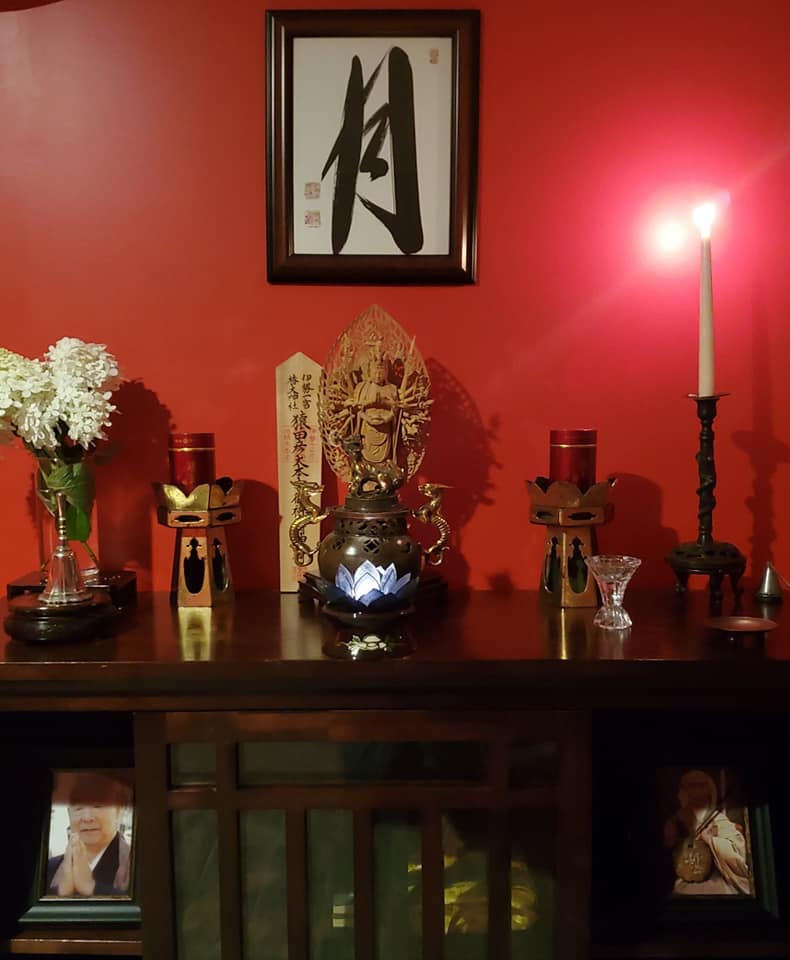
Zen Practice is one of those lifetime endeavors, it is not something we ever truly perfect. There are no “Zen Masters”, only students of the way. With this being said, it only makes sense that those senior Dharma bothers and sister help guide those with less experience. As with any endeavor, the longer and more diligent we practice, the more proficient we become at it. It takes a few years for a new student to begin to embody and experience the practice with any maturity. There is a lot of emptying and healing that must take place before we begin to see clearly. So for those students who have done a few zazenkai or sesshin and think they understand the practice…you don’t. Keep that “don’t know” mind and march onward. If you stay the course and apply yourself, the reward confirms your conviction. There are no shortcuts, and there are no formulations to learn and deploy. A few sits are a good start but, will not do. Relinquish your projections and settle into the form, and in the readiness of time, your roots will strike deep and the cool waters will nourish you. Wouldn’t that be wonderful?
The fear of death is the great usurper of life. We dress death in infinite suffering and pain, swathed in a dark cloak of totality. We attempt to hide, yet it always finds us. We try to ignore it, yet its patience always surpasses our own. It is only when we open ourselves completely to life, do we also open ourselves completely to death. Two sides of the same coin, within death there is life and within life there is death. So I ask you, when death comes and your elements scatter to the four directions, what of you then?
Unbridled waves playfully chase as they dance across the sands. Exhausted, empty, and vast, the ocean calls its own. Neither deep nor shallow, nor trench nor shore. Called forth, called home. A willows whisper, a lions roar.
When I first started to chant the “Great Vows” I was concerned that I didn’t know exactly what I was chanting. Moreover, the chants were in another language. I spent a lot of time researching various translations and attempting to chant it in English to “understand” it better. “It surely would be better if it was done in English”, I thought to myself. Why then are we chanting in Japanese? This line of questioning would carry over to all the other chants, a preoccupation with conceptual understanding. Understanding has its importance but, is there more to it? There is something in Zen Practice I like to call the “living word”. The best way to convey its meaning is to point to the experience of the word(s) not just the conceptual understanding. This “Living word” is only realized amongst the swaying pines and the summer breeze. It is the Rosetta stone of the dregs of Zen. Not only Zen but, all awakened residual that was playful left by saint and sinner. These fragments hint yet remain closed off like an iron mountain. When we open heart and mind and step into the moment completely, we step though the conduit of the word. Stepping through, the living word becomes our own and we “…see with the same eye and hear with the same ear…” as our ancestors. The word dissolves and we completely feel and experience the source. We return home. Today when I chant the “Great Vows” there is no thought, no forced concentration but, a complete immersion into the limitless experience of the sound. There is no chant and there is no one chanting, there is just the experience of returning home amongst the swaying pines and summer breeze. The next time you chant or read, I invite you to let go of the word, open yourself completely and allow the gate to fall away as the living word washes over you.
Sesshin is a great opportunity to experience Zen Monastic practice. Come join the Blue Mountain Sangha for Summer Sesshin, and gain true and lasting insight. “Sesshin”, literally “to collect the mind”, is the Zen Buddhist seclusion or intensive period, consisting of one to ten days of silent meditative practice. Included in these periods are daily Zazen, Dharma Talks/Teisho (sermons), Samu (work) periods, and private interview/meeting (Dokusan) twice daily with Ryuun Joriki Baker, Osho. During Sesshin, the Zen Student concentrates on nothing but collecting the scattered energies of the mind, so they may realize their true nature. For many, the awakened experience feels hidden and separate from our daily lives, in return, we seek it outwardly. It is only when we take a backward step, that we realize how intimate it truly is.
I remember early in practice wanting change so badly. Buddhism was to be my refuge and surely magical things would follow. It was a rude awakening, and letting go of a headful of ignorance was no small undertaking. Oh, the patience and understanding of my teachers. Not to mention my stubbornness used for positive change for once. I knew there was something there, I knew I had to find change and I knew I would not give up. Thirty years later and here I am. There was no magical occurrence yet there was something unexpected, that is for another time. So for all those students out there who “know” there is something to this Zen thing, you’re right. Use that faith and do not waiver in this endeavor. Keep at it, and even if your practice is off and on, find a teacher you can relate to and a group you feel comfortable with. Big or small temple, known or unknown teacher, these matter little. Is the teacher filled with joy, and is the sangha supportive of each other? Trust yourself, you will find the way.
Goal are needed and they give us direction, however, what happens when we are caught by setting and achieving goals? When we feel that ache and desire that arises pondering the obtainment of our muse. Often we become consumed when the blinders are placed on and we are off to the races. I can’t wait! If only! It is going to be so much better when! We begin to create a fantasy around the obtainment of our goal. Maybe more money, a new job, a car or even completion of our koans. I know for myself ordination was that, a unicorn, and the projected key to my discontentment. We fantasize and begin to fast forward through life, ignoring what we do have. Finally we get that new car, lump sum or koan completion. We experience great joy and wonder, for a short time. This is followed by that dreaded question….NOW WHAT? We feel let down, deflated and even panicked. In material sales they call it buyers remorse. WHAT NEXT? Most of the time we fall back on a goal or obtaining, and the process begins all over again. We are caught in a repetitive loop.. How much of of our lives are wasted over grasping? Next time you feel that ache or desire to obtain, remember that question that arises when the magic fades away, NOW WHAT? The strength to turn yourself around is found within the question.
Sesshin is a great opportunity to experience Zen Monastic practice. Come join the Blue Mountain Sangha for Summer Sesshin, and gain true and lasting insight. “Sesshin”, literally “to collect the mind”, is the Zen Buddhist seclusion or intensive period, consisting of one to ten days of silent meditative practice. Included in these periods are daily Zazen, Dharma Talks/Teisho (sermons), Samu (work) periods, and private interview/meeting (Dokusan) twice daily with Ryuun Joriki Baker, Osho. During Sesshin, the Zen Student concentrates on nothing but collecting the scattered energies of the mind, so they may realize their true nature. For many, the awakened experience feels hidden and separate from our daily lives, in return, we seek it outwardly. It is only when we take a backward step, that we realize how intimate it truly is.
Come join us for Full zazenkai (meditation service) at the Bushkill Temple for the first time in 1.5 years. All are welcomed. Members are free, visitors are $20.00.
Zen Practice appears to demand a great deal from us when we are distracted, and little when we are clear and rooted. Life ebbs and flows and so does our practice. Sometimes we are happy to jump right in, and other times we hesitantly dangle our toes in the deep spiritual waters. One of the obstacles in Zen Practice, as well as other traditions, is a sense of boredom. We may feel this boredom arises from many things, for our purposes we will focus on the teacher, and tradition. However, no matter what the reason, if we have convince ourselves that our boredom is due to outside causes, we are lost on the dark path of ignorance. In reality, the origins of our discontent are neither teacher nor tradition but, our unreal expectations of our spiritual path.
Trungpa Rimpoche coined the term “Spiritual Materialism” which pointed to the consumption of spirituality as though it was a commodity to buy and sell. In the west, this is very easily seen. For example, you have a smartphone but, that new one promises to be so much better! You discard the old one and purchase the new but, wait, after a few weeks that phone looses it charm and you need a new distraction. The cycle repeats over and over. We find ourselves chronicly unfullfilled and unhappy.
I always tell people there is no need to convert to any religion if they want to practice Zen. I remember clearly wanting to be a Zen Buddhist Monk when I first was exposed to Buddhism. I wanted something new, something to fill that desire and bring peace to my restless heart and mind. All those new chants, robes and rituals are pretty powerful. Adorning myself with Buddhist robes, malas, diction and a Dharma Name would empower me, so I thought. My path didn’t turn out anything like I had expected. Seeking someone or something to save you, will inevitable lead to dissatisfaction (suffering). The inevitable reveals distraction for what it is, and once again we find ourselves confronted with boredom and discontent. The choice to convert or switch teachers is ours to make, and it may take some time to it sort out. No matter what tradition or teacher we align ourselves with, the path to spiritual awakening will always require brutal honesty. Honesty with others, and most important, honesty with ourselves.
Established Zen Students may fall into spiritual materialism by chasing different traditions/lineages and teachers. After a few years their attention wanes and they begin looking outward once again. Their discontent waters the seeds of ignorance once again. For example, I always cringe when I hear someone seeking out a “new teacher” based on outside appearances or provocative ideas. When we begin to define a teacher by outward appearances and the ideas they convey, we are caught by the ego’s gravity. Granted there are great teachers out there, and it is certainly not a negative thing to learn different ideas or impliment different tool but, if we are seeking them for the wrong reasons, we are just moving further and further from that which would truly bring us peace and tranquility. One of my favorite koans “Gutei’s Finger” is a prime example of the importance of maintaining a root teacher. With time, we realize that the true Dharma is not an idea, nor a formulation to be chased. When the chase stops, and we realize that what we seek in not within others, we open ourselves to the inexhaustible Dharma that is us.
Although boredom still visits, I know it has nothing to do with teacher or tradition. I don’t start combing through the internet as though I was shopping on Amazon for a new pair of shoes. “If only I was there or I had that, things would be so much better.” Danger!
When we say “root teacher”, that is exactly what they are and what they do – root. They are our living koan and encouragement which remind us to remain rooted and awake in times of confusion, boredom and doubt. Even though seeking various approaches is healthy, we must also be aware of the games we play.